
Lower Merion Elite Roofing has handled gutter installation in Lower Merion, PA for more than 20 years, serving surrounding cities including Plymouth Township, Milford Township, Yeadon, Richland Township and West Norriton. We install seamless aluminum gutters, half-round copper gutters and downspouts, and we repair and reline the built-in box gutters found on many older houses.
We treat gutters as part of the roof, not as an add-on. A gutter that is too small for the roof above it, pitched the wrong way or hung below the drip edge sends water into the fascia, the walls and the basement. So we size and pitch every gutter to the roof area it drains, and we set it to catch what comes off the drip edge.
Every gutter estimate lists the gutters, downspouts, hangers, guards and any fascia repairs as separate lines. If we find rotted fascia when the old gutters come down, we show it to you before it is replaced.
Gutter Types We Install
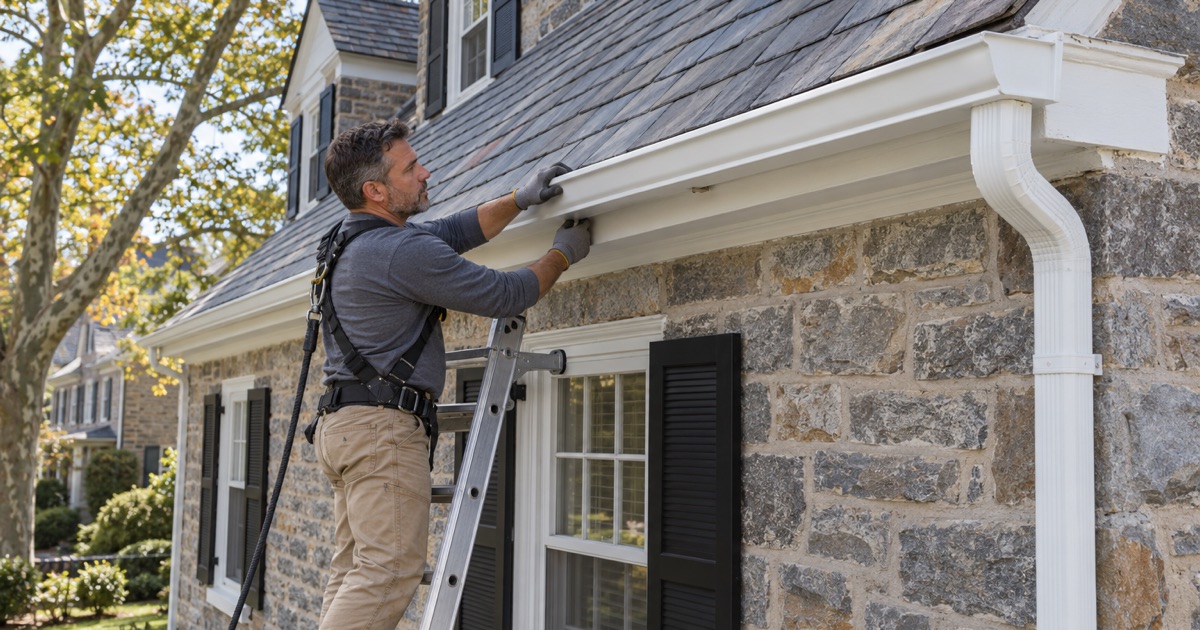
Seamless Aluminum K-Style Gutters
Seamless aluminum gutters are formed on site from a coil, so each run is a single piece cut to the exact length of the wall. The K-style profile carries more water than a half-round of the same width and matches most houses built in the last several decades. We offer them in a range of colors to match trim, and in 5-inch and 6-inch sizes depending on the roof.
Half-Round Copper Gutters
Half-round copper gutters with round copper downspouts are the traditional choice on Main Line houses with slate roofs and copper flashing. Copper weathers from bright to brown to green and lasts as long as the slate. We hang it with copper hangers and fasteners, because mixing metals causes galvanic corrosion where they touch.
Half-Round Aluminum Gutters
For homeowners who want the traditional look of half-round gutters at a lower cost than copper, half-round aluminum is a good option. It suits older houses with simple trim, and its round downspouts match the style of the house better than rectangular ones.
Box Gutters and Built-In Gutters
Many prewar houses have box gutters built into the cornice instead of gutters hung on the fascia. When their lining fails, water goes straight into the framing. We rebuild rotted wood, reline the trough with soldered metal or a membrane, and make sure the outlets and downspouts are large enough to keep up. Removing a working box gutter and hanging a modern gutter on the fascia changes the look of the house, so we only recommend it when the owner wants it.
Sizing and Pitching Gutters Correctly
Matching Gutter Size to the Roof
A gutter’s job is to carry away the water from the roof area above it. A large, steep roof sends more water into the gutter, faster, than a small, shallow one. We measure the area each run drains, factor in the pitch, and choose between 5-inch and 6-inch gutters based on the roof, not on what is easiest to install.
Pitch Toward the Downspouts
Gutters need a slight, steady slope toward each outlet so water does not sit in them. Too little pitch leaves standing water that breeds mosquitoes and rots fascia; too much looks crooked from the street and can send water over the end. We snap a line for every run and set each hanger to it.
Downspout Placement and Size
Long runs need a downspout at each end or a high point in the middle draining both ways. Where a valley dumps a large volume of water into a short section of gutter, we often add a downspout or upsize the existing one. Larger downspouts also clog less often, which matters under trees.
How Gutters Work With the Roof
Drip Edge and Gutter Height
Drip edge at the eaves directs water into the gutter instead of letting it wick back onto the fascia. The gutter has to sit high enough to catch that water and low enough that snow and ice can slide past without tearing it off. We set the height relative to the drip edge so water goes in the gutter and not behind it.
Fascia Repair and Lead-Safe Work
Rotted fascia boards cannot hold gutter hangers, so we replace damaged fascia before the new gutters go up. On houses built before 1978, painted fascia and trim may contain lead paint, so we follow the EPA’s lead-safe work rules when we disturb them, containing and cleaning up the dust.
Gutters During a Roof Replacement
When gutters are replaced with the roof, the new drip edge, ice barrier and gutter can be detailed together so they work as one system. When existing gutters are being kept, we protect them during the tear-off and clean them out at the end of each work day.
Gutter Repairs and When to Replace
Sagging Gutters and Failed Hangers
A gutter that sags between hangers holds standing water, which adds weight and pulls the hangers further out of the fascia. Old spike-and-ferrule hangers are the usual cause, because the spikes work loose as the wood swells and shrinks. We replace them with hidden hangers screwed into solid wood at closer spacing, and we reset the pitch while the gutter is loose so water runs to the outlet again.
Leaking Corners, Seams and End Caps
Even seamless gutters have joints at the inside and outside corners, the end caps and the downspout outlets. When the sealant in those joints dries out, water drips behind the gutter and stains the siding or rots the fascia. We clean the joints back to bare metal and reseal them with gutter sealant, or replace a corner section when the metal itself has corroded through.
Repair or Replace Your Gutters
Gutters with a few leaking joints and loose hangers are worth repairing. Gutters that are undersized for the roof, rusted through, crushed by ice or pitched wrong along their whole length are usually cheaper to replace than to keep fixing. We look at the full run before recommending either and give you the repair price alongside the replacement price.
Ice, Snow and Gutters in Winter
In winter, snow sliding off a roof can tear down a gutter hung too low, and gutters full of ice add weight that pulls hangers loose. Correct hanger spacing and a gutter set just below the plane of the roof help it survive snow. Ice dams that fill the gutter are a sign of attic heat loss, which is a roofing and insulation problem rather than a gutter one, and we will tell you so.
Downspouts, Drainage and Gutter Guards
Moving Water Away From the Foundation
A gutter that works perfectly still causes damage if the downspout empties against the foundation. We extend downspouts so water lands well away from the house, or connect them to an existing underground drain line where one is in place and working.
Gutter Guards Under Heavy Trees
Many neighborhoods in and around Lower Merion have large, mature trees, and their leaves, seed pods and twigs fill gutters quickly. We install gutter guards suited to the trees around your house, explain how much maintenance each still needs, and make sure the guards do not void the shingle warranty by lifting the first course of shingles.
Gutters on Twins and Attached Houses
On a twin, a gutter often runs continuously across both halves of the house. We look at where the water from each side ends up, add or move downspouts if one side is carrying more than its share, and coordinate with the neighbor when the work crosses the property line.
- 20+ Years Roofing
- Itemized Written Scopes
- Slate Repair Specialists